Nyheder
These Nuts May Contain Traces of Plastic
Plastic Change get’s ballsy with Father’s Day campaign! A NSFW warning about male fertility and microplastics on Fathers Day 2026
‘May contain traces of nuts’ is a universal disclaimer on food packaging and for those people with life-threatening allergies, it’s a vital warning about hidden toxic ingredients. But we should all be concerned about traces of something even more harmful that’s been sneaking into our bodies, including our most private parts: microplastics.
This year, Father’s Day and World Environment Day fall on the same date in Denmark. A reminder that the health of our environment and the health of future generations are deeply connected, and microplastics is one particular issue that affect both.
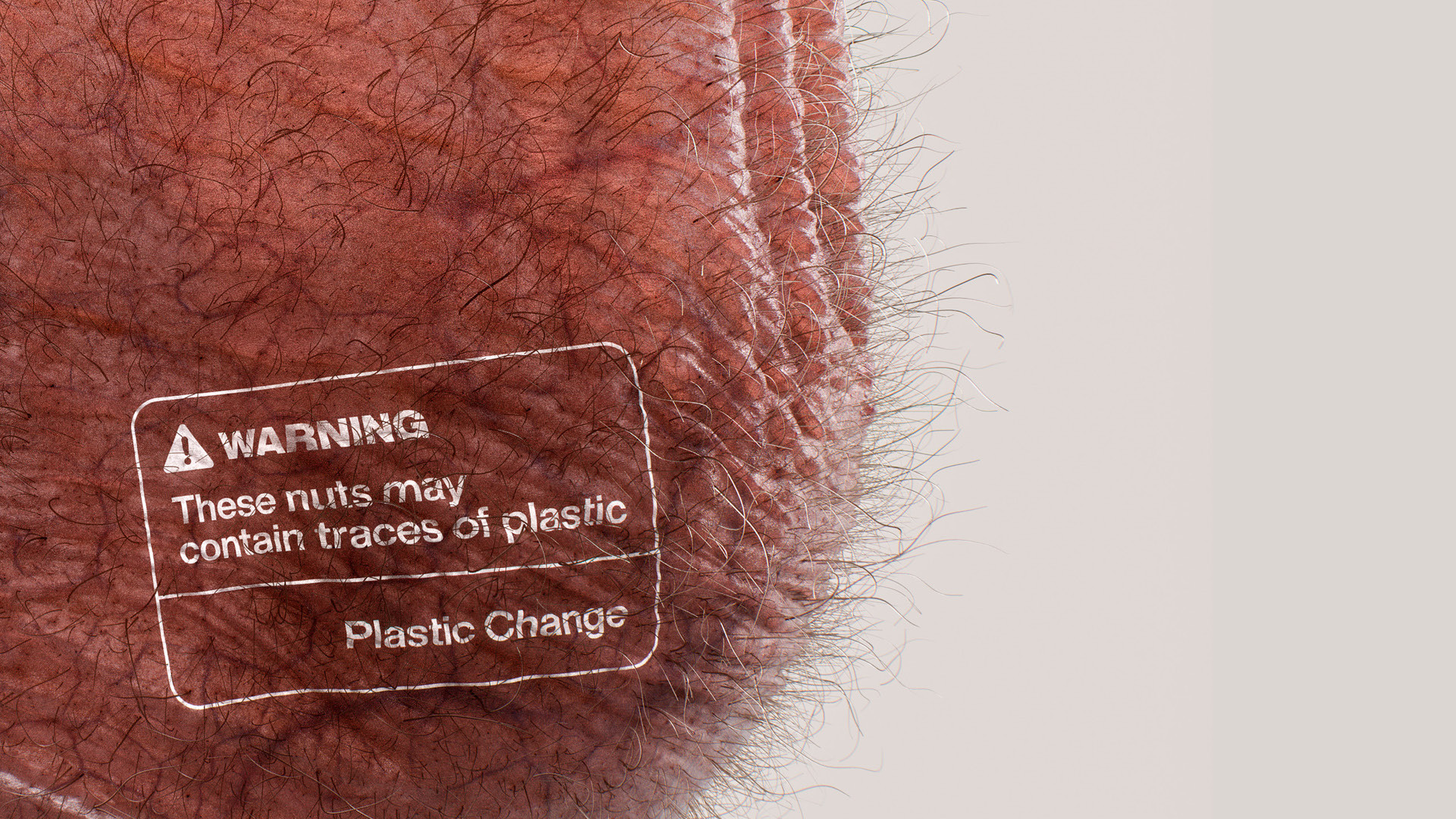
To shine a light on how the plastic pollution crisis is directly threatening male fertility, Danish NGO Plastic Change has launched a suitably ballsy campaign: These Nuts May Contain Traces of Plastic.
A kick in the nuts
Part visual gag, part health warning, the campaign is designed to stop people in their tracks, acting as a kick in the nuts.
The campaign takes a familiar food alert and twists it into a provocative, double-meaning message.
Hyper-real, close-up visuals of wrinkled testicle skin are presented like supermarket packaging, complete with nutrition-style labels listing microplastics as an “ingredient,” alongside potential side effects including infertility, hormone disruption and reduced sperm count.
Mounting scientific evidence and low awareness
- Microplastics have been found in semen, testicles, and even penile tissue1, with preliminary findings showing that men with microplastics in their testicular tissue have sperm counts roughly half those of men without2.
- Microplastic accumulation has been shown to suppress testosterone and the hormones that control male fertility, disrupting the body’s reproductive system at its root3.
- Global sperm counts have declined by more than 50% over the past half century4, with environmental factors, including plastic exposure, increasingly under scrutiny as contributors to this growing fertility crisis.
Yet despite mounting scientific evidence, awareness of the issue remains low, particularly among men.
Masculinity and microplastics
The creative strategy taps into a key behavioural insight: many men disengage from environmental messaging4. By reframing microplastics as a direct threat to male fertility and highlighting the issue towards fathers today and to the fathers of the future, the campaign transforms a distant global issue into something immediate and personal: their own bodies.
Henrik Beha Pedersen, founder of the Plastic Change and environmental biologist:
We are left in the darkness, not only men and their testicles, but humans in general, are left alone with microplastics in our bodies. We know that tiny plastic particles are invading our bodies. No one protects us from the health consequences. Plastic is not regulated by law. It’s a disgrace.
The EU just backed down on a planned revision of the chemicals law REACH and thereby also the intention to make plastic polymer registration mandatory. The industry pressure has a direct and unacceptable effect; humans are not protected against microplastics in our bodies. We need a plastic change. Otherwise we walk on towards an unknown future.

Even if you’re not interested in the environment, ask yourself if you can afford not to care about your reproduction.
Limit your microplastics exposure today and share the word!
Plastic Change and the fight against microplastics
Ever since the birth of Plastic Change we have worked hard against the constant exposure to microplastics. It’s an uphill battle, as the fossil fuel industry aims for exponential growth in plastic production.
But, we have several big wins that have made a significant impact on the exposure to microplastics in your everyday life.
Key impact on microplastics in your everyday life
✅ From 2020 it has been illegal to import and sell products in Denmark containing microplastics above a certain threshold6
✅ From 2023 the European Union restricts microplastics intentionally added to products. Expected to remove 500.000 tons of microplastics from the environment7
✅ Articial sports surfaces can no longer be filled with plastic. This is the largest intentional source of microplastics in the environment.7
✅ The microplastic content in cosmetics is also regulated by the 2023 measures. Avoiding significant exposure of microplastics directly on your skin.
✅ Monitoring and controlling the amount of microplastics in surface- and groundwater to reduce water pollution. Improving the EU Water Quality standard.8
Support our work for less microplastics in your nuts
11 Tips to avoid microplastics in your body
1. Drink tap water
The World Health Organization (WHO) points out that there are microplastics in our drinking water. However, groundwater in Denmark is well-filtered.
2. Use a steel water bottle
When you wash a plastic water bottle in the dishwasher, the hot water can cause a variety of chemicals and plastic particles to be released from the bottle. Use a steel water bottle instead.
3. Protect your children – use glass baby bottles
When a plastic baby bottle is filled with hot milk or gruel (baby porridge), plastic particles can be released. Use a glass baby bottle instead.
4. Check your personal care products
Many cosmetics and creams contains plastics, and it penetrates through the skin. Avoid products that have polymer or crosspolymer on the ingredient list.
5. Avoid plastic tea bags
Plastic tea bags release an unusually high amount of microplastics. Use a steel strainer or a pure paper filter instead.
6. Bring your own to-go coffee cup
Limit your consumption of to-go coffee in paper cups, as the inside is usually lined with plastic. Instead, bring and use your own steel thermal mug.
7. Hot food + plastic = a bad match
When you pack hot food into a plastic container, plastic particles can be released. Use a steel or glass container instead. If you must use plastic, let the food cool down before putting it into the container.
8. Cooking without melamine
Plastic cooking utensils can release plastic—especially melamine utensils—when they come into contact with boiling water or hot pans. Use steel or wooden cooking utensils instead.
9. Cleaning cloths and mops
Når du bruger skuresvampe, klude og gulvmopper, betyder slid, at der kan frigives plastik. Brug derfor istedet skuresvampe, klude og gulvmopper fri for plastik.
When you use scouring sponges, cloths, and floor mops, wear and tear means that plastic particles can be shed. Choose plastic-free scouring sponges, cloths, and floor mops instead.
10. Check your clothes
Synthetic clothing releases micro- and nanoplastics both when you wear it and when you wash and iron it. Many of these particles end up in the air, and you can end up inhaling them. Look for clothes that do not contain polyester, nylon, and elastane.
11. Remember the indoor climate
The dust in our homes contains micro- and nanoplastics from our clothes, carpets, furniture, curtains, and so on. Make sure to ventilate well, especially when you vacuum and clean, as this stirs up the dust.
These Nuts May Contain Traces of Plastic is the latest campaign from Plastic Change and Worth Your While, following the Bottle Bulge campaign in August 2025.
References:
1.1: Penile tissue. Codrington et al. (2024), International Journal of Impotence Research · The first study to detect microplastics in human penile tissue, finding them in 80% of samples taken from men undergoing surgery for erectile dysfunction.
1.2: Semen. Li et al. (2024), Science of the Total Environment · Microplastics were found in every one of 40 semen samples from healthy men in Jinan, China. Eight plastics were identified, the most common being polystyrene, followed by polyethylene and PVC.
1.3: Testes. Hu et al. (2024), Toxicological Sciences · Microplastics were found in every one of 23 human testicles studied. The researchers said the discovery may be linked to the decades-long decline in sperm counts.
2: Sperm count. Grigoryan et al. (2025), Human Reproduction · Preliminary findings from a review of 15 studies covering 1,200 men, presented at the ESHRE 2025 conference, found that men with microplastics in their testicular tissue had sperm counts of 12 million/mL, against 26 million/mL in those without (roughly half).
3: Hormones. Qu et al. (2024), Science of the Total Environment · Microplastics accumulating in the testes suppressed testosterone and the hormones that govern male fertility — FSH, LH and GnRH — demonstrating cause and effect in a controlled study.
4: Global sperm decline. Levine et al. (2023), Human Reproduction Update · A landmark global analysis showing average sperm counts have fallen by more than 50% over the past fifty years, with environmental factors including plastics among the suspected causes.
5: Behavioural insight. Brough et al. (2016), Journal of Consumer Research · Seven studies found that men often avoid eco-friendly behaviours because green choices are stereotyped as feminine, leading some to disengage to protect their masculine identity.
6: Bekendtgørelse om forbud mod import og salg af kosmetiske produkter, som afrenses, der indeholder mikroplast
7: Protecting environment and health: Commission adopts measures to restrict intentionally added microplastics
8: Parliament adopts more stringent rules to reduce water pollution
This campaign was made possible thanks to the generous pro bono work of the following contributors:
The Campaign is created by independent creative agency Worth Your While and is centred on a series of deliberately shocking OOH executions across Denmark. Behind the provocative visuals – is digital imagery studio We Are Eli.
Client: Plastic Change
Creative: Worth Your While
Creative Director & Partner: Tim Pashen
Creative Director & Partner: Lukas Lund
Design Director & Partner: Carl Angelo
Creatives: Katrine Winblad, Monique Marie Funch, Isa Bella Madelena Normark, Frederik Emil Vedersø Larsen, Frida Snekkerup
Chief Strategy Officer: Tali Madsen
Project Management: Christine Gyrsting Lorentzen
Production: We Are Eli
Media Agency: WPP Media
Media Placement: Ocean Outdoor